Jazz up your interior with this stunning Canvas Acrylic Painting of Sarah Vaughan (1924-1990) by Cleveland Artist, Michelangelo Lovelace (1961-2021). This painting features the award-winning singer with eyes closed in the midst of song. She stands behind a microphone in an off-shoulder red dress and two well-dressed musicians behind her. A colorful, vibrant, energizing piece for any room!
Collector's Notes:
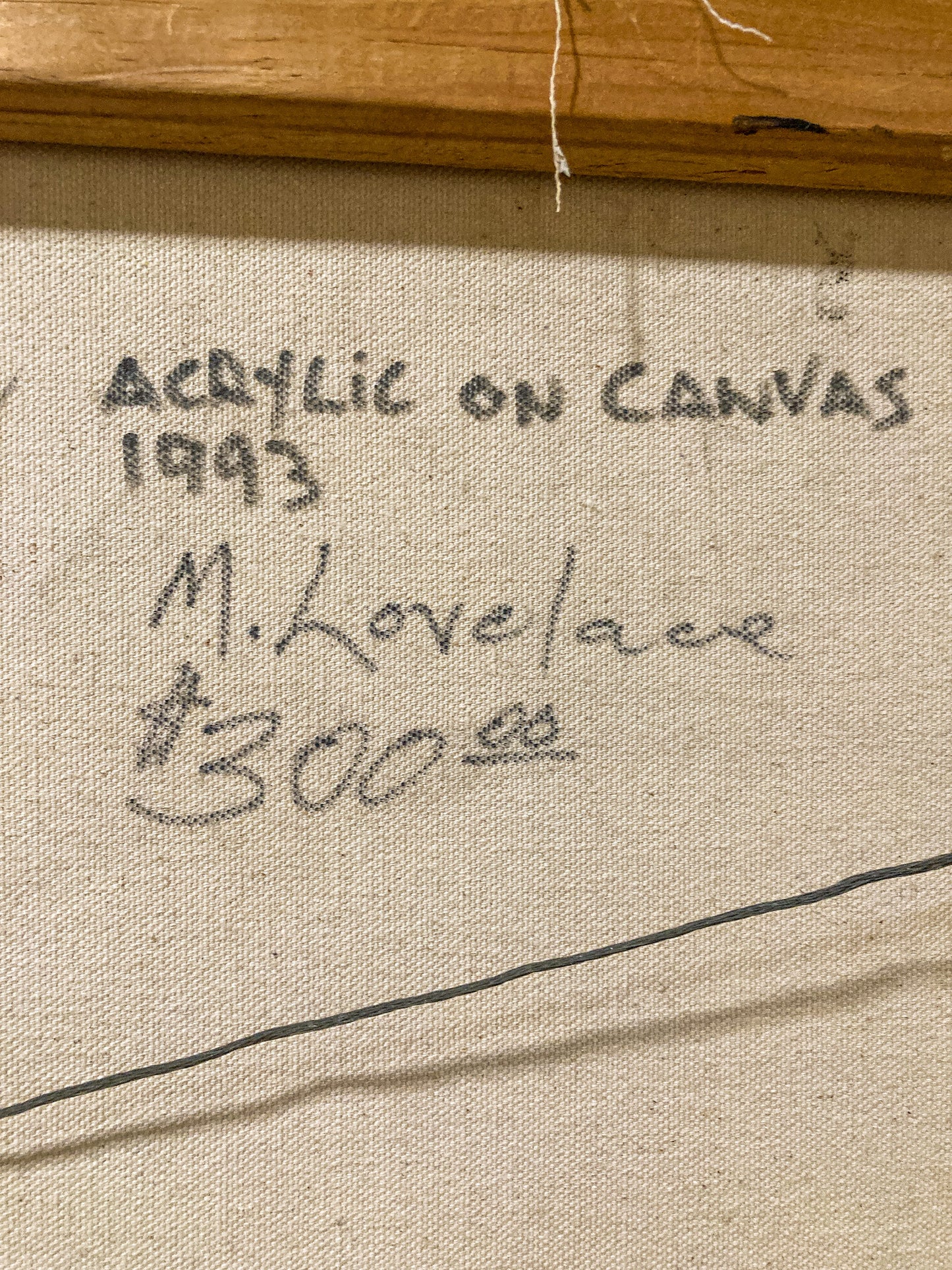
1993 Michelangelo Lovelace Portrait Sarah Vaughan Canvas Acrylic Painting; Labeled "Ms. Sassy" on the back which refers to one of the nicknames Sara Vaughan acquired during her career likely after her 1956 album, "Sassy". She was also called "The Divine One" and the "Queen of Bebop". Throughout her career, she won two Grammy Awards. She was an acclaimed singer and musician.
Condition: Very Good
Expected wear for age; minor scuffing and denting to frame, particularly corners; no visible damage to canvas. Inspect images and videos.
Overall Size: 37" x 25"
Michelangelo Lovelace, American (1961-2021)
When Michelangelo Lovelace (1960–2021) spoke about his life and career as an artist, he almost always began with this story: As a teenager growing up in Cleveland’s King Kennedy public housing complex, he dropped out of school to support his family. He found a variety of means to do so, some legal and some illegal. When he was nineteen, he was arrested for selling marijuana and appeared before a judge. In Lovelace’s own telling, “the judge said, ‘What can you do?’ So, I told him I could draw. He said, ‘Well, you come back down here again, I’m sending you to prison. You’d better stick to drawing.’”
Lovelace took the advice to heart. In his twenties, he studied art at Cuyahoga Community College and the Cleveland Institute of Art. He dropped out of school again, this time to make a living for his own children, and he faced poverty, addiction, and the loss of loved ones. Nevertheless, he maintained his dedication to art and crafted a unique style, seeking energy and directness.
After receiving technical training and gaining knowledge of art history, Lovelace chose to paint in an intentionally simplified manner because it allowed him to show what he called “the raw power of life in the inner cities of America.” He depicted crime, drugs, poverty, and sin, but also community, compassion, progress, and salvation. He portrayed the environment he knew—the bricks of public housing, advertising billboards, familiar intersections—as well as political events, social allegories, and scenes from his career in art.
Lovelace hoped for ideas and experiences to flow straight from his mind to the canvas, as honestly and forthrightly as he could manage. This allowed him to process and contend with harsh experiences, and to express himself to others. Before his life was cut short by pancreatic cancer, he had shown his work from New York to Los Angles and was thrilled with what he had achieved. Taking stock of his personal journey and the sense of purpose that he found in creativity, he remarked “I’m one of those people who say ‘art saved my life,’ and it truly did.”
Source: Akron Art Museum